Project XP-38N
A site dedicated to the memory of those
who designed, built, flew, and
maintained the Lockheed P-38 Lightning in
defense of freedom.
P-38 details: data and information pertinent to virtual modeling
by David C. Copley, last updated 30 May 2009
[this is a work in progress]
This article attempts to abridge and consolidate a number of P-38 references that contain important data and information pertinent to modeling the P-38 for flight and combat simulation.
My complete reference listing may be found at the end of this page. Primary references include private correspondence with former P-38/F-4&5 pilots, the book America's Hundred Thousand, the P-38 Pilot's Manual, period and contemporary videos.
[Click here for detailed photographs of P-38s]
Ground Handling
The P-38's front wheel was a caster and was not directly controllable by the pilot. Steering was accomplished by differential throttle and braking. The pilot's manual stressed the former over the latter, to conserve brakes.
Pilots reported that once the plane began moving at a slow speed the force of the airflow from the propeller on the rudders made it possible to easily steer with the rudder pedlas, just as if the nose wheel were steerable.
I have observed the ground handling in a number of period and contemporary videos, as well in person, and it appears that the aircraft was easily controlled around corners and through taxiways using the aforementioned techniques. I was surprised to see that the turning radius was quite tight for its size.
Take-off
With zero wind and a hard, dry surface, a minimally-loaded P-38H/J/L could take off in a very short distance: 900 ft. Minimum take-off distance for earlier Lightnings was approximately 1,400 ft. A fully-loaded J could take off in 1080 ft under the same ideal conditions. Of the USAAF fighters, only the P-40E had a shorter take-off distance with full load (1070 ft), and it was about half the weight of the P-38J!
Some sources suggest pilots regularly used flaps for take-off, other sources suggest they only did so when a short take-off was necessary. The pilot's manual suggests normal take-off is performed WITHOUT flaps, but up to 1/2 flaps may be used for short take-off.
Observing a video of a restored L, I timed a take off on a hard, dry, modern runway. With the propellers at full RPM and brakes on, the pilot released the brakes and was airborne in about 11 seconds. It took 7.5 seconds to accelerate from 0 to 70 mph. The gear took approximately 7 seconds to retract.
The aircraft would lift off the runway between 100 to 110 mph, and required very little effort to pull it up in the air. But it did require effort -- meaning the plane did not rise into the air automatically as some taildraggers do.
Climb
Once airborne and "clean" (gear retracted, etc.), many pilots said that the the P-38 would climb like a "homesick angle." (But then again, this phrase was employed to describe most WWII fighters! :-) )
The early P-38s could climb from sea level to 20,000 ft in about 8 minutes. Later variants (H+) could reach 20,000 ft in 7 minutes. The original design goal was six minutes.
Flaps
Fowler flaps were part of the initial design.
The MANEUVER setting was introduced in mid-production of the F model (F-15). The MANEUVER setting pitched the flaps down 8 degrees and were often used for take-off and more importantly, combat, to decrease turning radius. Thus, this setting of the main flap system was sometimes called "COMBAT" flaps.
When the flaps lever was moved out of the MANEUVER setting, the flaps would roll back on rails while also increasing pitch to 8 degrees. Besides the MANEUVER setting, there were to two other automatic settings: "UP" "DOWN." By manually adjusting the flaps lever, the pilot could set the flaps anywhere between fully retracted and fully deployed.
Hydraulically boosted ailerons ("power steering")
Until the J-25 and L/M, it took quite a lot of "muscle" to roll the plane as its speed approached or exceeded 300 mph. The late models (J-25 and on) had hydraulically boosted ailerons.
Dive-recovery Flaps
Dive recovery flaps were developed to mitigate compressibility during high speed dives. The P-38 was one of the first planes to encounter this phenomenon. Dive recovery flaps became standard equipment from the J-25 on. Some earlier J's were retrofitted with these flaps.
Dive flaps were positioned on the underside of the outerwing, just outboard of the engine nacelles. When deployed, a powerful electric motor would push one end of the flap, causing the flap to fold outward along a hinge. From the side, the dive flaps have a "V" profile.
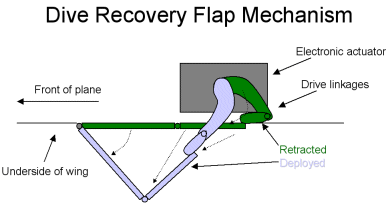
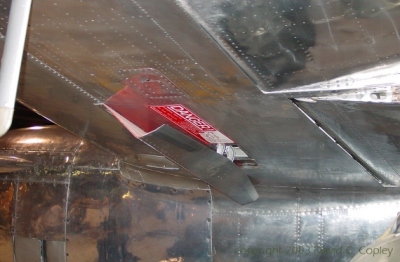
Left wing's dive flap fully deployed.
In the manual, it states that the dive recovery flaps deploy in less than 2 seconds. When demonstrated on a video with the aircraft on the ground and stationary, I timed their deployment at 1 second. One would expect a slightly increase in deployment time in flight, due to the opposing force of the moving airstream. Pilots reported that when deployed in level flight, the nose would "pop up" very quickly, followed by a steady decrease in airspeed.
Typically, the dive-recovery flaps were deployed just before entering a dive. I have observed period film taken from P-38 gun cameras that suggest pilots could dive straight down for several thousand feet and still recover by deploying these flaps.
These flaps are NOT the so-called "COMBAT" flaps. See section on Flaps.
Roll
Generally, roll rate increases with speed. In early models, up to and including the J-20 production block, this trend held true until about 300 mph. Beyond 300 mph, roll rate became more of an issue of pilot strength, as the increasing force required on the control wheel required a lot of "muscle." Beginning with J-25, hydraulic boost allowed faster roll rates at speeds beyond 300 mph.
Between 250 mph and 300 mph IAS, the rates were similar for both earlier and later models, and were approximately 70 - 80 degrees per second (4.5 - 5 second roll).
Turn
Without employing the MANEUVER flaps, the P-38 did not turn as well as most other US planes. It had the largest minimum turning radius of all fighters. For comparison, it's minimum turning radius was about twice that of the FM-2 Wildcat. The flaps helped decrease turning radius at the expense of speed. The MANUEVER flaps helped, but still did not make the P-38 into legendary dogfighter.
Acceleration
The P-38 had perhaps the fastest linear acceleration of all US propeller planes during WW2 (This was true to for all variants for their respective times) . For example, starting at sea level at 250 mph and applying COMBAT power the P-38L's linear acceleration was 4.13 ft/s2 (1.26 m/s2), whereas the P-51D's linear acceleration was 3.85 ft/s2 (1.17 m/s2).
Cruise and Range
Typical combat radius for the J/L variants was 275 miles for 410 US gallons of fuel (no external tanks) and 650 miles with 740 US gallons (w/ 165 gal external tanks). These ranges allowed for 20 minutes combat at target and 30 minutes of reserves. With 300 gal tanks, missions were made over ranges in excess of 1000 miles and durations of nine hours or more.
Landing
With full flaps, "over-the-fence" speed was about 110 mph, flare at 80 - 90 mph.
Armament
From the E model on, most P-38s were equipped with four 0.50 caliber machine guns (up to 500 rounds per gun) and one 20 mm cannon (up to 150 rounds). The original design called for a 25 mm cannon, and very early models had a 37 mm cannon.
The 0.50 caliber machine guns fired at 800 to 900 rounds per minute, with a muzzle velocity of 2,550 to 2,840 ft/sec. The effective range was 300 yards. All 2000 rounds could be fired in over 33 seconds.
The 20 mm cannon fired 600 rounds per minute with a muzzle velocity of 2,920 ft/sec and effective range range of 1,200 yards. Continuous firing duration was 15 seconds.
The L and M were produced equipped with Christmas-tree style rocket launchers. Some Js and earlier models were retrofitted with the Christmas-tree launcher. Bazooka-style rocket launchers (triple-tube cluster) were also known to have been fitted to the fuselage.
Loads
The empty weight of the J model was 12,780 lbs compared to the YP-38, which weighed 11,196 lbs. A nominally-loaded J, with guns, oxygen equipment, trapped oil and trapped fuel, etc. weighed 14,100 lbs. With the pilot, ammunition, fuel, and useable oil, the J weighed about 16,200 lbs on take-off.
The very early P-38s (prototype and prove-design) could carry 400 - 410 gallons of fuel internally. Beginning with the D, internal fuel capacity decreased to 300 gallons. When the intercoolers were moved to the enlarged "chin" internal fuel capacity was restored to 410 gallons.
The P-38 used two sizes of external fuel tanks depending: medium-sized tank made from 24-gauge sheet steel that could carry 150 - 165 US gallons and a large tank made from wood that could carry 300 - 310 US gallons.
- The 150/165 gallon tanks decreased the planes speed by about 4%, and weighed 90 lbs each when empty.
- The larger tanks required additional braces when attached to the plane to prevent them from wobbling too much in flight. They were used for very long range missions and ferrying, and were jettisoned only in emergencies. Pilots were not to exceed 250mph indicated when carrying the large tanks. Extreme caution was required when dropping empty 300 gallon tanks, as they could hit the airplane when released. They had to be released at very low speeds (120 mph indicated, with landing gear and flaps up -- a rather dangerous condition should one lose an engine).
Later model P-38's were capable of carry two 2,000 lbs bombs, nearly the bomb load capacity (in weight) of a B-17!
Engine Power Ratings
| Variant | Military Power | Combat Power (WEP) |
| XP-38 &YP-38 | 1150 HP ea. | n/a |
| P-38F & P-38G | 1325 HP ea. | n/a |
| P-38H | 1240 HP ea. | 1600 HP ea. |
| P-38J & P-38L | 1425 HP ea. (some references state the L Military Power was rated to 1475 or 1500) |
1600 HP ea. (some references list L WEP at 1725, but it is believed that this was obtained at higher rpm's and higher boost pressures than the std 3000 rpm, 60 in.) |
At Military Power, the manifold pressure was 47" for the F and G, and 54" for the H, J, L and M. WEP manifold pressure was 60".
Turbo-Superchargers
GE Type B turbo superchargers were used on the P-38. These were the same type as used on the B-17 and other planes.
On late model airplanes, the B-33 turbo-superhcargers were regulated to 24,000 rpm for normal operation and 26,400 rpm for WEP. Critical altutude for the turbo-supercharged engines was 25,000 feet. Above critical altitude the turbo's were held at constant either 24,000 or 26,400 rom depending on throtttle position. Manifold pressure drops approximately 1.5 in-Hg per 1000 feet above critical altitude.
Cockpit
Unlike most fighters of the time, all variants of the P-38 had a control "wheel" rather than a "stick." The prototype had a full wheel, much like a car and early production versions 3/4 wheel. Later versions had more of a yoke, as might be commercial and general aviation aircraft today.
The Lightning's panel layout was notoriously complicated. Gauge arrangement changed seomwhat from variant to variant. Early models had separate RPM and MANIFOLD PRESSURE gauges for each engine (i.e. Left RPM, Right RPM, etc.). Later models had single (but dual-needle) gauges for each function (i.e, dual-needle L&R RPM in single gauge, etc.).
Cockpit heat was a recurring problem and a major pilot complaint until the L model.
The canopy hatch opened to the right on earlier models (XP-38 through early F) and to the rear on later models (later F through M).
The seat was adjustable up/down but not fore/aft.
References
Books- P-38 Lightning in Detail and Scale Part 1: XP-38 through P-38H, Bert Kinzey. Squadron/Signal Publications, 1998.
- P-38 Lightning in Detail and Scale Part 2: P-38J through P-38M, Bert Kinzey. Squadron/Signal Publications, 1998.
- P-38 Lightning in Action, Larry Davis, et. al. Squadron/Signal Publications, 1990
- P-38 Lightning in World War II Color, Jeffrey L. Ethell. Motorbooks International, 1994.
- Lockheed P-38 Lightning (Warbird Tech Series), Frederick A. Johnson. Specialty Press, 1996.
- Peter Three Eight The Pilots Story, John Stanaway. Pictorial Histories Publishing Company, 1986.
- P-38 Lightning Aces of the ETO/MTO, John Stanaway. Osprey Publishing, 1998.
- P-38 Lightning Aces of the Pacific and CBI, John Stanaway. Osprey Publishing, 1997.
- Lockheed P-38 Lightning (Production Line to Frontline Series), Michael O'Leary. Osprey Publishing, 1999.
- Pilots Manual for Lockheed P-38 Lightning, Lockheed/US Army circa 1944. republished by Aviation Publications sometime in the mid 1970s.
- Lockheed P-38 Lightning, Steve Pace. Motorbooks International, 1996.
- America's Hundred Thousand, Francis H. Dean, Shiffer Publishing, 1997.
- Fork Tailed Devil, Martin Caidin, iBooks, 2001 (original printing 1972).
- The P-38J-M Lockheed Lightning, Profile Publications no. 106, 1966.
- The P-38 Lightning, Pamela Reynolds and the P-38 National Convention, Turner Publishing Co., 1989.
- The Lockheed P-38 Lightning, Warren M. Bodie, Widewing Publications, 2001 (first printing 1991).
- The Lockheed P-38 Lightning, Edward T. Maloney, Aero Publications, 1968.
- Comouflage & Markings: Lockheed P-38, F-4 & F-5 Lightning USAAF ETO & MTO 1942 - 1945, Ducimus Books Ltd
- Fighting Lightnings, Michael O'Leary, Osprey Publishing, 1988.
- Famous Aircraft Series: The P-38 Lightning, Gene Gurney, Arco Publishing Co., 1969.
- P-38 Screamers: the history of the surviving Lockheed P-38 Lightnings, A. Kevin Grantham, Pictoral Histories Publishing Co., 1994.
- P-38 Lightning: Restoring a Classic American Warbird, Jesse Alexander, Motorbooks International, 1990.
- American Eagles: P-38 Lightning Units of the Eighth and Ninth Air Forces, Roger Freeman, Classic Publications, 2001.
- Lockheed P-38 Lightning: A Pictoral History, Anthony Shennan, Historian Publications, 1968
- Crowood Aviation Series: Lockheed P-38 Lightning, Jerry Scutts, Crowood Press, 2006.
Magazine Articles
- P-38 Lightning -- Flight Journal special issue dedicated entirely to the P-38, Summer 2003.
- Flying the P-38 Lightning: A Dream Comes True -- article by the late Jeff Ethell, Flight Journal, Summer 2001.
Mutlimedia
- P-38 Lightning -- Restorations Illustrated vol 2 CD/DVD set, published by Buffies Best (www.buffiesbest.com)
Web pages
- Der Gabelschwanz Teufel
- P-38 Training Video
- USAF Museum - Lockheed P-38
- 33rd Photo Recon Squad Online
- P-38 National Association
- Combat Aircraft article on the P-38M (no longer available)
Videos
- Great Planes, Series 1, Volume 10 (P-38), Aeroco, Inc. 1989.
- Warbird Checkout No.1 "P-38 Flight Characteristics", (and other period films), Historic Aviation
- Lockheed P-38 Lightning, Program Power Entertainment, 1997.
- P-38 Inspection, (USAAF period film for mechanics), EAA Paul Harvey A/V Center.
- Heavy Metal: P-38 Lightning Strikes! History Channel/A&E Entertainment, 2001.
Interviews
- Private interviews with the late Lt. Col. William C. Sharpsteen II, who flew with the 339th FS/ 347th FG in the South Pacific
- Private communications with other P-38/F-5 pilots whom I have not obtained permission to mention their names.
- Private interview with Bob Cardin, Glacier Girl project manager.
- Interviews w/ P-38 pilots by Jerry Lindell, available at http://www.sim-outhouse.com/
About this article
This artical began as an informal list of flight characterisitics for my my FS models. In 2002, when I heard that Microsoft was putting a P-38 model in their Combat Flight Simulator I put this article online in hopes they would find it and use it to make the model more accurate. (I had heard through some insiders that it had a lot of inaccuracies). I'm not sure they ever used my page -- the P-38 model was only so-so -- but over time others have built P-38 models and I felt it would be good to keep adding to this list for their sake.