Project XP-38N
A site dedicated to the memory of those who designed, built, flew, and maintained the Lockheed P-38 Lightning in defense of freedom.
Glacier Girl's First Flight
(I was there!)
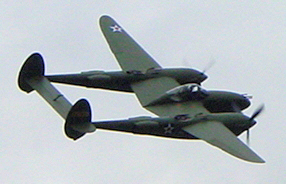
by David C. Copley
28 Oct 2002
MIDDLESBORO, KY -- Some 60 years after landing on Greenland's ice
cap and after decades being buried in hundreds of feet of snow and
ice, a rare, perfectly restored P-38F took to the skies again, this
time over its new home in Middlesboro, KY.
The story of "Glacier Girl" is fairly well know in aviation circles,
and details can be found at the official site:
www.thelostsquadron.com . I have been following its progress since I
first read about it in Bert Kinsey's book P-38 Lightning, Part 1 (In
detail and scale series) four years ago. At that point, the
restoration was already in its sixth year. Having been enamored with
the P-38 since my youth, I vowed that I would see Glacier Girl fly
and as the big day approached I did all I could to make it there,
despite living some distance away from south-eastern Kentucky.
On Friday Oct 25, 2002, the day before the flight, I checked the
"Lost Squadron" website to see if the flight was still on, as the
weather did not look very cooperative. But, putting faith in the
forecast for cloudy skies (but not rain), I began my 1,200 mile
round trip to Middlesboro, driving the distance alone through rain,
rain and even more rain.
Saturday morning the Autumn skies over south-eastern Kentucky were
cloudy and threatening. I arrived six hours before the scheduled
event and I was worried it might be cancelled. Yet there were
already perhaps a thousand people there. I quickly toured the
hanger/museum, where mechanics were making last-minute
inspections/adjustments to the plane. Everyone seemed optimistic the
weather would hold out, so I staked out a spot that through sheer
luck ended up being at the front of the crowd, literally right in
front of the plane. Unfortunately, I didn't plan well enough and did
not have a lawn chair to sit on, or food to eat, etc. So, in order
to keep my spot, I stood the entire time! Boy, the things I'll do
for a P-38!!! :-)
I had a great time waiting for the event. I met some P-38 pilots and
other WWII veterans, lots of other people from all over the country
and some local folks who had helped with the restoration project.
When the ceremonies began, the MC stated that some 20,000 people
were in attendance, lined up all up and down the runway, with
probably several thousand in the main section, where I stood crammed
with all the other nut-cases that got there 6 hours before!
My impressions? Awesome. I don't use that word very much, because it
is overused. But, I was truly awestruck by the
accomplishments spoken of during the ceremonies. Everything from the
brave pilots and crew of the "Lost Squadron," their rescue and
rescuers, the recovery efforts in Greenland, the 10-year, incessant
restoration, the extent of detail to get everything perfect, the
support of the local community and citizens of Kentucky to help
sponsor the project, the brave pilot who was to fly it -- it was all
awesome. And then the plane stole the show, as expected.
The flight almost didn't happen though. They had to have certain
minimum weather conditions (more strict than usual) to satisfy the
FAA and the insurance company. (One guy who lives in Middlesboro
told me it cost $75,000 to insure it just for that flight!
Apparently the plane is valued at several million dollars.)
After a slight delay (weather related) the plane was pulled out and
away from the crowd. The ground crew checked it over and the pilot
got in and started her up. The crowd went wild with the start of
each engine. The reaction of the crowd was almost like one hears at
a sporting event when the winning team scores, or at a rock concert
when the band plays an old favorite.
After warming up a little, Glacier Girl -- flown by noted warbird
pilot Steve Hinton -- taxied and prepared to depart from runway 10
to the east. For a few minutes, the plane was out of my site. Then
we heard a low rumble, which quickly grew louder. Pretty soon people
began shouting, "here it comes!"
The sight and sound of that P-38 taking off is truly a moment frozen
in my memory. Having put so much effort into studying, modeling and
"virtually" flying the P-38, this was actually a very emotional
experience for me. It was hard to hold back tears of joy. A tingle
shot down my spine as I reminded myself that this was the real
thing. This was history in the making! I looked around and saw
several WWII veterans with handkerchiefs to the moist eyes. I'm sure
many of them have a very different kind of fondness for the plane,
one that I cannot fully understand.
The pilot handled the plane very gingerly, and rightly so. A T-6
(flown by the P-38 restoration project leader, I believe), which had
taken off moments earlier acted as the spot plane and met the P-38
as it came around its first left-hand turn from take-off. The flaps
and gear were tested as they went around the first time. Another
plane (a Kingair, maybe?) which had brought the Governor of Kentucky
to the ceremonies then moved in and flew close formation with
Glacier Girl. I'm guessing this was for in-flight photos and perhaps
the History Channel (and I believe The Governor was on board). After
that, the P-38 circled a few more times, making low passes as it
approached the airfield, allowing all us spectators to snap photos
and cheer wildly. Finally, the gear came down and the P-38 landed.
Again the crowed roared. It was over. I had finally seen a P-38 fly.
During the flight, I noticed how quiet it was. That surprised me a
little. The sound from the T-6 often masked the P-38. But, then
again, The P-38 pilot never used full throttles except perhaps on
the take-off. The guy next to me had a radio tuned to the pilot, so
we could hear him speaking to the chase plane and the ground crew.
It sounded like most of the time he had the engines well below their
maximum power. Earlier that morning, when they revved up Number 1
for the History Channel crew, it got quite loud, and I got great
recordings (which is one of main reasons I went ;-) )
Below are some of the photos I took during the event. I took many
close up photos of the plane while it was still in the hanger. Those
are included in the "Walk-around" section of this web site. Be
sure to click on the two short MPEG videos I took. They're not great
quality (they're from my digital camera, which is much better at
taking stills) but they give some sense of the excitement of being
there.
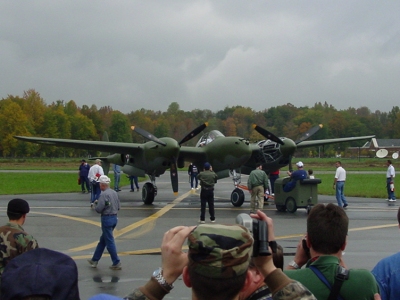
Several hours before the flight, the crew pushed the plane out a
ways to test the engines. Note the bare left engine.
Click here for a low-res MPEG video during engine test.
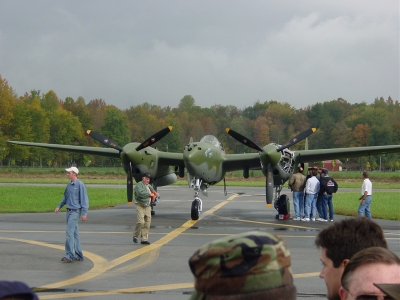
The sun came out a bit, giving a better sense of the true color of
the restored P-38F.
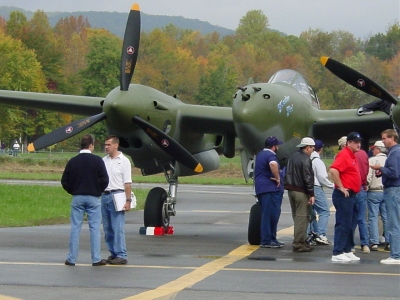
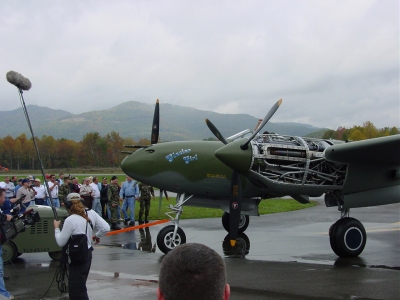
About an hour before the flight, they towed the plane to the fuel
area to gas up. Note the boom mic on the left and the camera. That's
the History Channel crew.
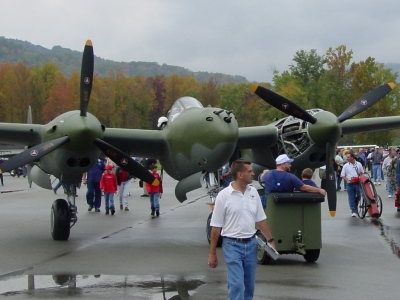
Returning to the taxiway after fueling up.
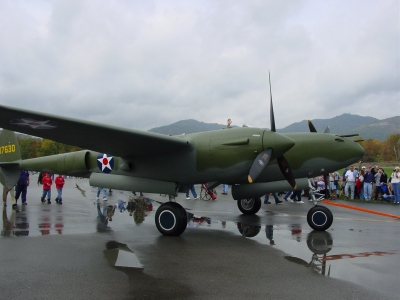
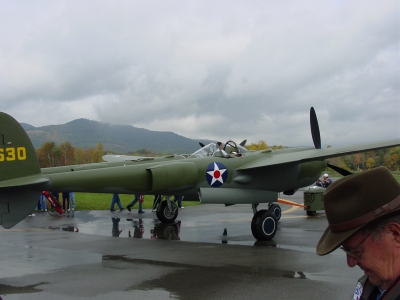
As you can see from this photo and the others, Middlesboro is
essentially in a bowl-like valley, completely surrounded by hills.
It is believed that the bowl is a meteriorite crater.
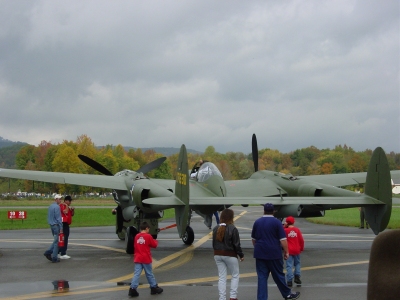
Note the flat paint (not gloss), painted exactly to original USAAF
specifications.
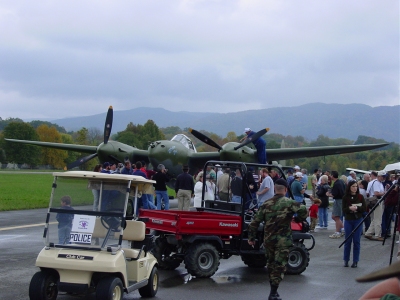
With the left engine covers on, the plane is ready to go!
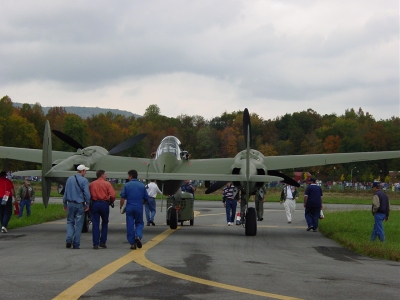
Being towed out a ways before starting engines.
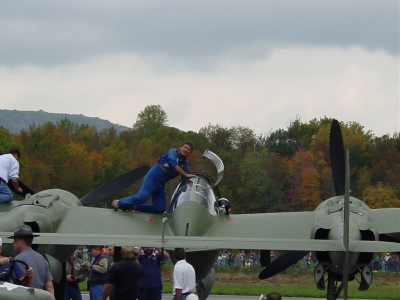
Pilot Steve Hinton climbs in. (Note the canopy folding to the right,
indicative of the early-model P-38s. In fact, the change to the
rear-swinging canopy was made during F-series production, so Glacier
Girl is an early F (P-38F-1-LO 41-7630).
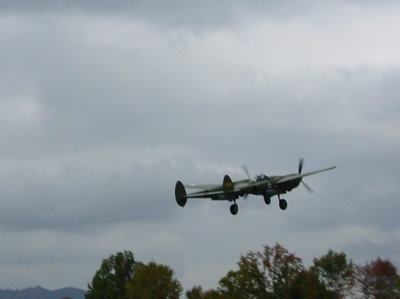
Take-off!
Click here for a low-res MPEG video of fly-by
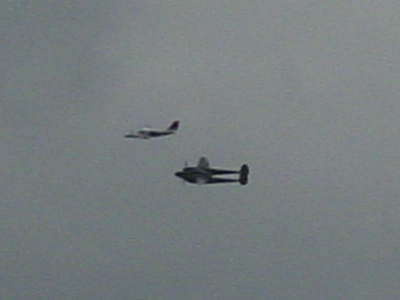
Kentucky Governor's plane flying close formation, presumably for
photos.
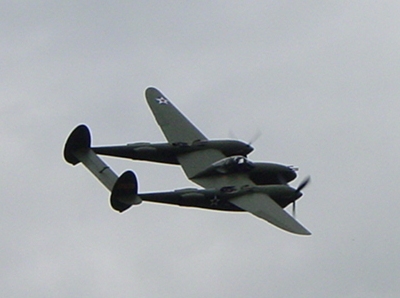
This one turned out pretty good!

Gear down, ready to land. The other plane is the chase plane.
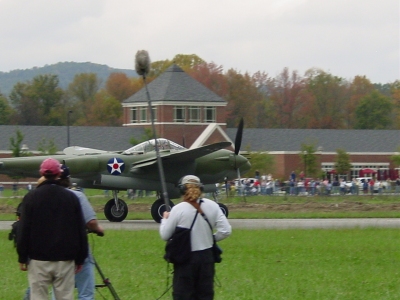
Seconds after touch-down. There's the History Channel crew again!
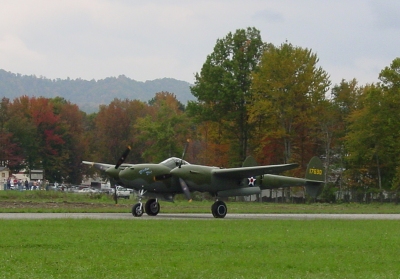
Coming back, the crowd is cheering!
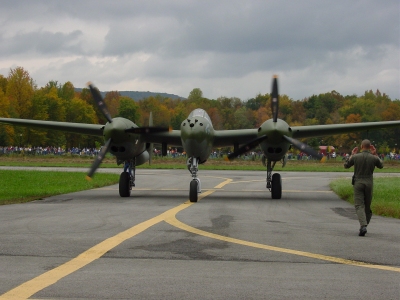
Pulling up to the crowd.
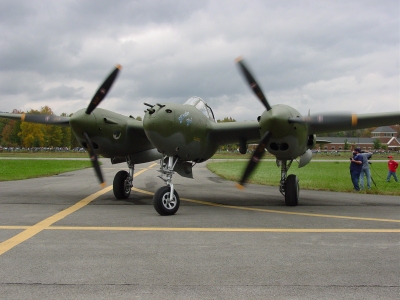
Great shot showing the use of differential throttle & brakes for steering.
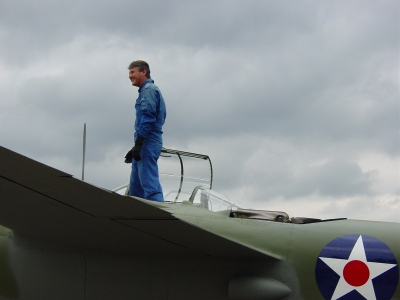
One very happy pilot!
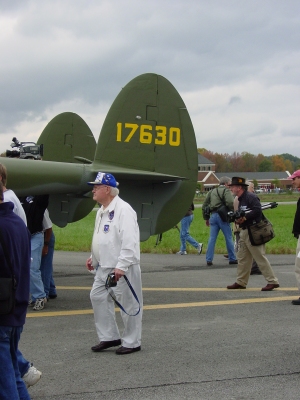
I was told that this gentleman in white was one of the original crew
of the "Lost Squadron."
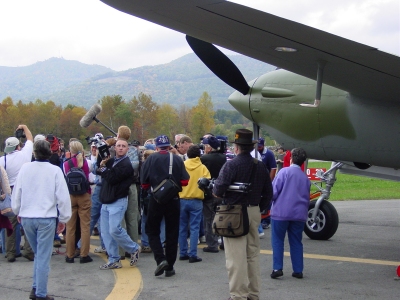
Media swarms the pilot.
photos copyright (C) David C. Copley 2002
GG: P-38E or P-38F?
On the left side of every P-38, just below and forward of the cockpit, the plane's type, serial number and other details are stenciled in black leters for identification purposes. If you ever see Glacer Girl up close, you will notice it is marked as a "P-38E" but it is considered a P-38F-1.
Apparently this was how it really was. When I asked about it during one of my visits, I was told this was because it was originally ordered as an E but during production it was built as an F. The restoration crew faithfully restored every aspect of the plane, even little quirks such as this.